
step seven - discover horsemanship philosophy & Methodology in the round pen
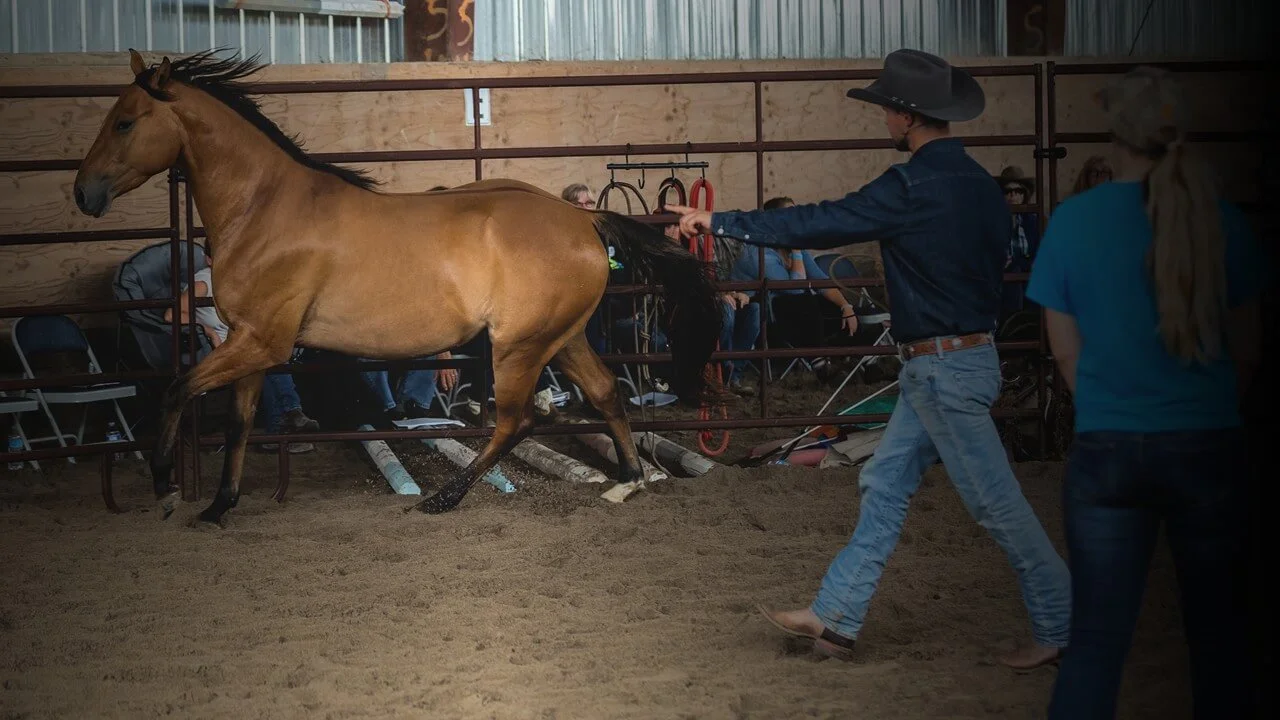
Round Pen - Speed Control
Step Seven - Speed Control & Control of Fear in Different Speeds in the Left & Right Direction - Discover Horsemanship Philosophy & Methodology in the Round Pen
Goals:
Horse learns body language and voice cues for each speed asked to travel
Horse learns to walk, trot and lope consistently in both directions
Horse learns how to transition in different speeds
Horse learns patience
Horse learns to control emotions and respond consistently when changing speeds in both directions
Human learns to become consistent, coordinated and control his own emotions
Problems Solved:
Horse learns methodology for speed control
Horse learns to control emotions at different speeds
Horse learns to lunge at different speeds without becoming upset
A horse that will not slow down without becoming upset on the trail or in arena
A herd bound horse riding on the trail
A horse that is unable to control his speed and emotions when riding back home to the barn
A dull horse that will not respond to a faster gait
A horse that cannot handle different situations such as trailer loading, trail riding or riding alone
When I meticulously designed each step that I utilize in the round pen, I carefully considered the various problems that individuals commonly experience with their horses and how these specific steps may effectively resolve those issues. One prevalent challenge is when the horse does not travel at the desired speed that we expect. Often, the horse either moves too slowly, racing ahead too quickly, or may even resist movement altogether, showing reluctance to engage in the desired work.
Horses have learned to run to survive, making it difficult for them to manage their emotions when they are moving quickly. At high speeds, they can become alert, anxious, and nervous, driven by their survival instincts. This next step, #7, will help address or prevent various issues you may encounter with your horses. Here are some of those problems.
Problems can include horses that want to run nonstop, whether alone or with others on a trail. Some horses may always seek to be in front or prefer staying close to their buddy. This approach can also help with horses that rush out of the barn or want to return home while riding, as well as barn sour horses or any horse struggling to manage their emotions.
Controlling speed can be an issue in the arena when you want to slow your horse, but it continues to run through the bridle without slowing down. This can upset the horse and lead to dangerous situations. Step #7 is a helpful way to solve or prevent these problems.
I will also talk to you about how some horses cannot control their emotions when working in different speeds, and how they fall apart emotionally, and also how some people cannot control their emotions when they are working with their horses and how they also may fall apart. You might be asking if this can be fixed. We can't achieve our goals with horses when we're emotionally upset. I will share how I manage my emotions while working with horses and how to help our horses control their fear and feelings.
To work effectively with a horse, we must understand its nature and how it manages stress. We also need to reflect on ourselves, considering our communication style, body movement, and reactions to various situations. Think about whether we move quickly or slowly and how we handle stress. How do we interact in both positive and negative moments? Do we show respect to others? When teaching our children manners or discipline, are we setting a good example to help them grow into better people? All these aspects influence how we manage our emotions and stress, which we inevitably pass on to our horses.
We show our feelings in how we behave with our horses at the barn. Are we gentle, respectful, and loyal to them and other animals? How often do we pet our horses softly on the ground or in the saddle to let them know they please us? Our hands are crucial in this connection, as we communicate our emotions through them. Some people tap their horses, thinking it’s a reward, instead of giving a loving rub or caress.
Many people feel anxious a day or two before loading their horse into a trailer, often due to past accidents. This stress can affect the horse, making it harder for both to manage their fears. While some horses struggle to control their anxiety, so do some people, and not everyone will succeed. We can help them improve by exposing them to different situations. This process is emotional for both horse and human. It's important to remember the previous steps in my philosophy and method used in the round pen. You have begun teaching your horse to manage fear and emotions, and you are building a safe relationship with them.
When we work with our horse at a steady speed, they perform well and stay relaxed. However, when we change the speed, the horse may struggle, and some horses can’t manage their emotions when the speed increases.
To teach the horse speed control, start by getting him to move forward in the round pen. Choose a direction and ask the horse to trot calmly and steadily. Use clear body language to guide him along the round pen wall. It's essential that the horse respects your space and moves in a continuous circle. Use clear body cues and consistent voice commands, without the use of whips or other tools. Allow the horse to make a few circles around you. Once he seems comfortable, gently ask him to speed up without using too much body pressure, ensuring he does not become frightened. When he speeds up, maintain that consistent speed for several circles. Then, ask him to change his speed, either faster or slower.
Ask your horse to go at your desired speed, then increase the speed and quickly slow it down by releasing pressure. Increase the speed again right away. Initially, your horse may become agitated, but focus on sensing their body language during this step. Don't spend too long here; avoid making this feel like punishment for the horse. This is not our goal.
As you practice controlling your horse's speed and managing their fear, also focus on turning outside and inside while throwing the lariat. You can gradually change the speed from slow to fast and then back to very slow. Keep working on this step, and you'll be surprised at how quickly your horse learns to handle these transitions and manage their emotions without getting upset.
It is also very important when you have finished this step or session that you give your horse lots of love so that your horse will understand that you are working on controlling fear and emotions and that you are not punishing him. Take your time and try to understand your horses and feel their heart their soul and try to understand how they may fell no matter how dull or how sensitive he may be and try to find a way to reach him and not make him upset and afraid of you.
To effectively slow your horse down without relying on a halter or rope, you can follow these carefully outlined steps. First, recall step #5, where you previously taught your horse to turn left and right on cue. Now, position yourself in front of your horse’s shoulder, then quickly step back to release the body pressure you have applied. This action should encourage your horse to begin slowing down, and while it may not come to a complete walk immediately, it will certainly consider the option. Allow your horse to continue moving at a steady trot, and remember to utilize consistent body cues along with clear voice commands to communicate any desired changes in speed.
Keep your horse moving along the wall of the round pen to prevent him from leaning in. This helps him learn to respect your space and travel in a straight line. You can teach him to do this without using tools or tapping him on the head or neck, as I believe those methods show aggression.
Your horse will understand you if you have completed the earlier steps. These steps are essential as they help your horse learn what we want, starting in the round pen and later moving to the saddle.
In step #7, you can practice different speeds with your horse, such as slow or fast walks, energetic trots, and smooth lopes. You can control the speed effectively by turning either inside or outside, which influences the horse’s pace. Continue working steadily until your horse feels both comfortable and relaxed. To adjust speed appropriately, ask your horse to turn outside while quickly releasing pressure to help them slow down, or conversely, apply pressure to encourage them to speed up. This practice will enhance your communication and horse's responsiveness.
It's important to teach my horse to walk at different speeds because we want him to fully understand our cues and respond calmly and reliably, regardless of the pace we are asking him to maintain. This training not only enhances his responsiveness but also builds his confidence in varying situations.
Once again, I would like to remind you that it is crucial for your success in horsemanship to diligently complete all of the previous steps. This includes executing turns inside, turning outside, and turning between two defined points consistently. Additionally, remember to practice throwing the lariat effectively. It is also essential to perform all of these tasks at various speeds, including the walk, to ensure a well-rounded mastery of each skill.
You may find that the walk can often be the most challenging gait to successfully accomplish in my philosophy and methodology as part of the round pen program. This difficulty arises because horses naturally have an instinctual desire to run, as it is deeply embedded in their survival mechanisms. You may also notice that when you ask your horse to slow down, he may instead respond by speeding up. This common reaction typically occurs when you are requesting him to turn inward or when you throw the lariat toward him. It is essential to understand these instincts and reactions as you work to establish control and communication with your horse.
Eventually, as you diligently work through these essential steps, your horse will come to accept your cues, develop a deep respect for you, and learn to control his emotions and manage his fear. By consistently building his confidence, he will ultimately respond in a calm and relaxed manner, making your partnership more enjoyable and effective.
It may take some time and patience until your horse becomes fully comfortable and confident while traveling at different speeds, but you will begin to see the fruits of your labor when you consistently accomplish this important step. As your horse learns to understand your cues and signals, you will find that your first ride with your young horse feels safe and free of frustrations. You will be able to walk, trot, and lope with a flag confidently in your hand, without holding tightly to the reins or feeling the anxiety that often accompanies the fear of being bucked off. In this harmonious partnership, you and your horse will experience genuine happiness and positive emotions shared between you, with no fear disrupting the wonderful connection you are building. This success is a direct result of your horse's mind having been adequately prepared to manage and control his emotions at the various speeds that you are asking of him, leading to a stronger and more trusting relationship.
To learn more about the complete step by step program including tutorial and videos of “Discover Horsemanship Philosophy & Methodology in the Round Pen” join Russ Krachun Performance Horsemanship at the “True Grit Academy” Virtual Education.