
Episode 001 - Beyond Pressure and Release - Developing the Horse Through Timing, Repetition and Progressive Education
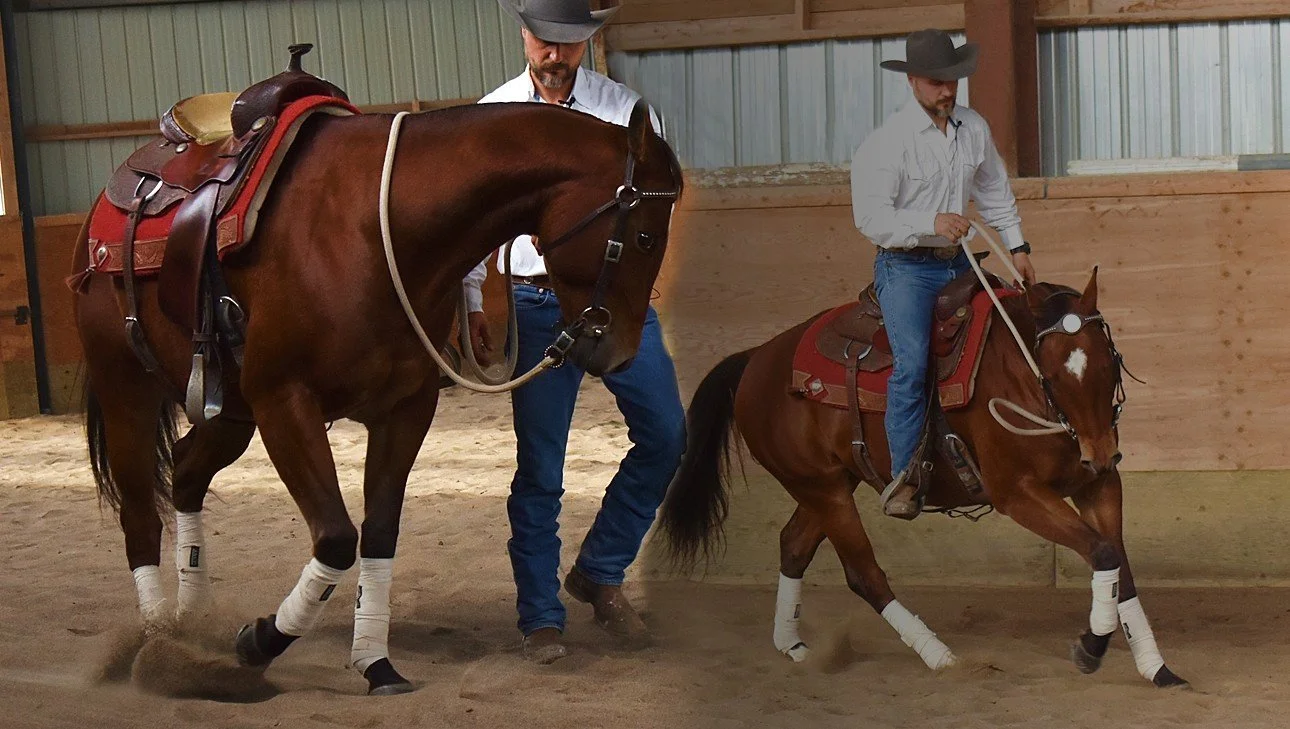
Beyond pressure and release - Developing the Horse Through Timing, Repetition and Progressive Education
I would like to share with you my theory of horsemanship and explain why I believe timing, repetition and progressive development within each physical exercise are so important to educating the horse.
My goal is not simply to teach a horse to respond to a cue.
I believe we should educate the horse's mind and body together.
Through appropriate physical exercises, correct timing, repetition and gradually increasing the duration of an exercise, we can give the horse the opportunity to develop balance, coordination, flexibility, strength and muscle memory while also increasing mental understanding.
This is the foundation of my approach to horse education.
Let's Think Beyond What We Have Been Taught
Throughout many years of horsemanship education, respected horsemen and women have taught us to use pressure and release as a method of communicating with and educating the horse.
We are often told that this is how horses communicate with one another.
Horses use energy, body language and physical pressure to establish boundaries and communicate within the herd. One horse may move toward another horse, and the other horse may step away. Sometimes a horse will move toward the pressure rather than away from it.
I agree that horses communicate with one another in these ways.
But I believe we need to look deeper.
What Is Happening Between Horses?
When one horse moves its head toward another horse and the other horse does not respond, the first horse may bite.
When a horse moves its hindquarters toward another horse and the other horse does not move away, the horse may kick.
These interactions can involve dominance, boundaries and natural survival instincts.
The horse receiving the pressure may move away, stand its ground or respond with greater pressure.
This is a form of communication between horses.
But we have to ask ourselves:
Is this interaction designed to develop the other horse's balance, coordination, flexibility, muscle tissue or mental understanding?
I don't believe it is.
The horse is responding to a natural social interaction and, at times, to its instinct to protect itself or avoid conflict.
That is very different from deliberately educating a horse to develop a physical skill.
A Response Is Not the Same as Development
This is where my philosophy differs.
When we pick up the reins, apply our legs or use an in-hand cue, we can create a response by applying pressure.
The horse may feel pressure or discomfort around the mouth, rib cage, shoulder, hindquarters or another part of the body and respond in order to find the release.
The release can reinforce the response we wanted at that particular moment.
But I believe we need to ask a much bigger question:
What has the horse actually developed?
Has the horse developed better balance?
Has coordination improved?
Has flexibility increased?
Have the muscles and supporting tissues been appropriately developed?
Has the horse developed muscle memory for the movement?
Has the horse developed a deeper mental understanding of the exercise?
Or have we simply taught the horse how to respond to a particular cue?
For me, getting a response is only the beginning of education—not the end goal.
Developing the Horse's Mind and Body
I believe the horse needs more than a cue-and-response relationship.
We need to provide the horse with physical exercises that have a purpose.
Those exercises should connect to one another and progressively develop the horse's abilities.
When we work with a horse on the ground or under saddle, we have an opportunity to educate both the mind and the body.
We can teach the horse to understand communication while simultaneously asking the body to develop:
Balance
Coordination
Flexibility
Strength
Body control
Symmetry between the left and right sides
Muscle memory
Physical confidence
At the same time, the horse is developing mental understanding, concentration and willingness.
This is what I mean by educating the whole horse.
Why Timing Matters
One of the most important elements of my methodology is timing.
Every physical exercise has a beginning, a duration and an ending.
If we ask the horse to perform an exercise for only a moment, we may create a response.
But when we gradually increase the amount of time the horse can correctly maintain that exercise, we create an opportunity for further development.
This is similar to developing a human athlete.
An athlete doesn't become stronger simply by being shown an exercise.
The athlete develops through correct movement, repetition, appropriate duration, recovery and progressive increases in physical demand.
I believe the horse can benefit from the same principle.
Repetition Creates Understanding
Repetition is also essential.
But repetition should not mean simply doing the same thing over and over without purpose.
It should mean repeating a correct movement so the horse has the opportunity to understand, coordinate and retain it.
When the exercise is performed correctly, we can gradually increase the timing and duration.
Through this process, the horse can begin to develop muscle memory.
The movement becomes more familiar.
The horse becomes more coordinated.
The body becomes better prepared.
The mind begins to understand what is being asked.
And the horse becomes more capable of performing the movement with less dependence on the horseman's intervention.
Every Exercise Should Connect to the Next
This is another important part of my philosophy.
I don't believe exercises should exist as isolated movements.
One exercise should prepare the horse for the next.
The education should progress logically.
The horse learns one physical and mental concept, and that understanding becomes part of the next stage of education.
This creates a step-by-step process in which the horse's abilities can continue to develop.
Rather than constantly looking for a different cue, a different tool or a different way to create a response, we can concentrate on developing the horse's ability to understand and perform.
My educational Philosophy
I am not saying that pressure and release cannot produce a response.
It clearly can.
My concern is that a response alone should not be confused with complete education.
My goal is much greater than obtaining a reaction from the horse.
I want to develop a horse that understands.
A horse that can think.
A horse that can coordinate its body.
A horse that can develop balance and flexibility.
A horse that can build appropriate physical ability.
A horse that can retain what it has learned.
And ultimately, a horse that becomes increasingly willing to communicate with the horseman.
That is why I believe in timing, repetition, progressive development and connected physical exercises.
Discovering the Methodology
I will share these methods with you through future True Grit Conversations.
As you follow the program, I believe you will begin to see how the pieces connect.
You may be surprised to discover how the education that begins in Discover Horsemanship Philosophy and Methodology in the Round Pen — Foundation Level One can connect to the horse's future education under saddle.
The round pen is not simply where we begin teaching a horse what to do.
It is where we begin developing the communication, understanding, physical awareness and mental foundation that can continue into every stage of the horse's education.
The goal is not simply to make the horse respond.
The goal is to educate the horse.
Mind and body.
One exercise at a time.
One step at a time.
One stage building upon the next.
Want to Continue Your horsemanship education?
If you've enjoyed these conversations and are ready to deepen your understanding of horsemanship, I invite you to continue your education with our TRUE GRIT ACADEMY.
Whether you prefer Private Instruction with personalized guidance or the flexibility of our Virtual Instruction programs, you'll discover a structured, step-by-step learning experience designed to help you develop a willing, confident horse through communication, understanding, and education.
Wherever you are on your horsemanship journey, we're here to help you take the next step.
TRUE GRIT ACADEMY - PRIVATE INSTRUCTION
TRUE GRIT ACADEMY - VIRTUAL INSTRUCTION