
Step Eight - Discover Horsemanship Philosophy & Methodology in the Round Pen
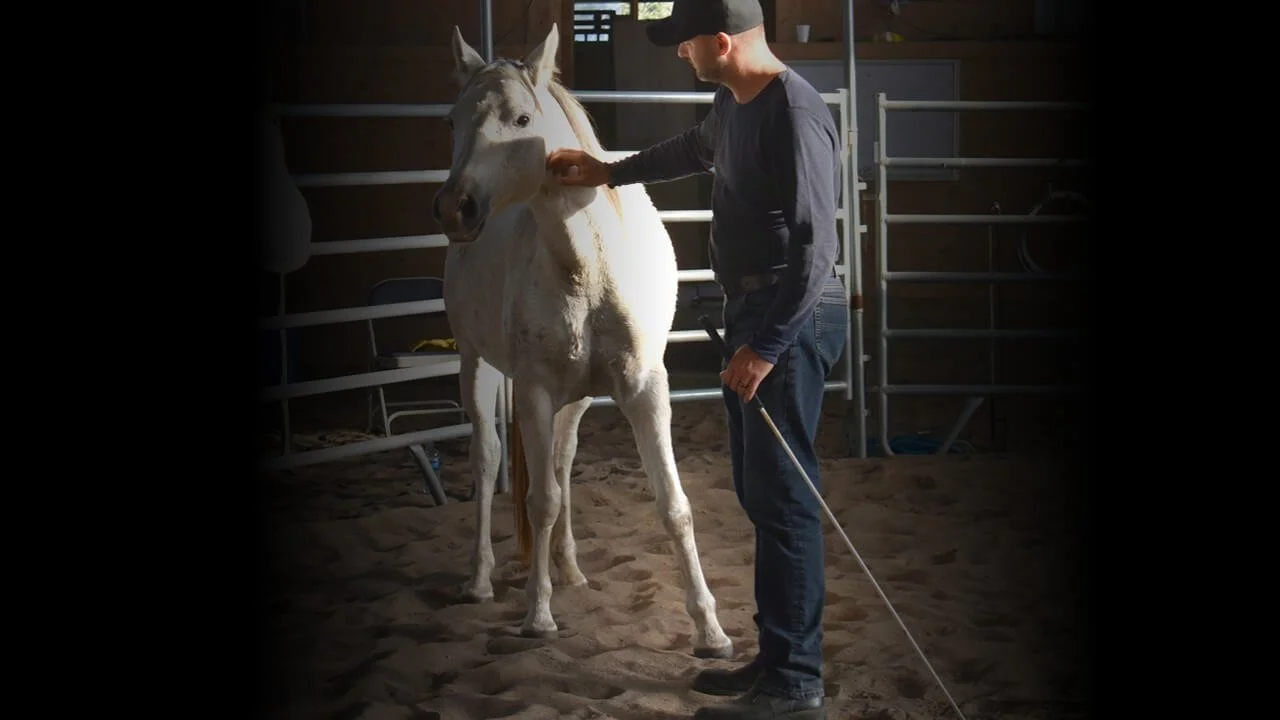
Round Pen - First Physical Touch
Step Eight - First Physical Touch with Hands on Both Sides up to Withers - Discover Horsemanship Philosophy & Methodology in the Round Pen
Goals:
Horse learns to accept the human walking towards him for the first time and stands still from left and right sides
Horse learns to trust the human by letting the human join up to him ( human to horse join up - not a horse to human join up)
Horse learns to accept the smell and first physical touch with human hands on right and left sides of the horse body up to the withers
Horse learns to trust, join up and follow the human
Horse learns to accept human trust and touch
Problems Solved:
A horse that has no confidence with human contact
A horse that does not stand still when grooming, tacking or feeding
A horse that does not stand still when mounting
A horse that does not stand still for the farrier
A horse that runs away from you
Lack of trust between the horse and the human
I have the pleasure of working with two remarkable horses recently, and I have brought each of them through my comprehensive horsemanship program. The first horse is a two-year-old quarter horse mare cross named Cassie, while the second is a ten-year-old quarter horse mare named Angel; notably, both of these horses had not experienced any previous groundwork and had not been started under saddle before our time together. These two horses present very unique challenges for different reasons. Angel is a horse with trust issues stemming from her past experiences, which makes her a particularly nervous and anxious mare. In contrast, Cassie exhibits a more dominant personality and tends to challenge me with acts of defiance. In my work with both of these horses, I find that I need to employ a significant amount of patience and understanding. Interestingly, the behaviors displayed by both of these horses serve to teach us valuable lessons in patience and persistence if we truly want to achieve success with them in our training endeavors.
There are truly no secrets in my comprehensive horsemanship program, as I am consistently and thoroughly breaking down each individual step that I utilize when working with my clients. Furthermore, I take the time to explain and demonstrate to them in a clear and observable manner how their horse is progressing throughout the training. In every case, these clients can hardly believe their eyes when they witness firsthand what each horse is learning during this enlightening process. I would also like to emphasize that the steps I employ are completely distinct from many other common approaches that are often used in round pen work today. Once again, I would like to clarify that it was not I who originally discovered the concept of round pen work; rather, I have developed my own unique "Philosophy and Methodology in the Round Pen." My ultimate goal is that by incorporating these steps, I can inspire a transformation in how many individuals choose to work in the round pen in the future.
I would like to take this opportunity to share with you some thoughtful examples illustrating why it may be potentially dangerous for your horse to join up with you in certain situations. When the invitation for connection arises from the horse’s idea rather than your own intention, complications can occur. For instance, I have witnessed individuals repeatedly run their horses around and around in the confined space of the round pen. When they finally ask the horse to join up, the horse will often approach, smell the person, shake his head, and then unexpectedly turn to kick at them. To me, this reaction signifies a lack of trust and understanding between the horse and the person involved.
When a horse approaches you with curiosity but then quickly runs away as soon as you attempt to touch it, it clearly indicates a significant lack of trust between you and the animal. Consider the behavior of wild animals such as horses or deer; when you move towards them with the intention to touch or interact, they generally perceive you as a potential threat and will immediately flee because they do not have confidence in your intentions. Picture yourself in an open prairie, where a wild horse unexpectedly charges in your direction; your instinctive reaction would likely be to run away, driven by that same issue of trust that exists in the animal world.
I have learned that it can also be very dangerous, especially when working with certain stallions or with some horses that may never have been handled properly to work in the round pen without developing a solid foundation of trust first. Learning from my own previous mistakes and experiences, I have dedicated significant time and effort to understand how to effectively build this all-important trust, which is essential in order for me to continue working with horses in a safe and controlled environment. I realized that when you walk towards any animal and it does not instinctively run away, you have already begun to establish an incredible level of trust and leadership with them, which is vital for a successful partnership.
Let's now continue with Step #8 of my comprehensive philosophy and methodology in the round pen. In this next important step, I believe it represents not only a critical phase but also the pivotal key to opening the door, or you may say, the key to unlocking the heart and soul in the process of developing a deep and meaningful trust between the horse and the human. This is an essential aspect of our journey together.
If you have not yet successfully completed the previous training steps, or if you have not effectively taught your horse how to stop and face you, or if your horse does not have any understanding of how to turn inside, or if you have not thoroughly finished the extended touch exercise or any of the earlier steps, it is entirely possible that both you and your horse may encounter challenges and ultimately fail to achieve success in this particular step.
It is also crucial for you to remember that you cannot touch your horse behind the withers during this particular step; this restriction exists because we have not yet taught our horse to respect our presence and authority from his hind end at this stage of training.
We will begin our training session by first asking our horse to move forward consistently and steadily. Once he is traveling at a nice, calm speed, you will then gently ask him to stop and face you. When he successfully stops and turns to face you, he should be looking at you with attentive ears, and at that moment, you will also look straight at him with open and inviting shoulders. It’s crucial that you do not look down or turn away from him; maintaining eye contact is essential. You want him to develop a sense of trust in you, and you will need to earn this important aspect of leadership in your relationship with him.
As he is standing still, begin to walk slowly and deliberately toward him by first moving to your left and then shifting your direction to the right until you are in close proximity to him. Once you are near, gently ask him to engage with you by extending your hand for him to smell. This interaction is very important because it should be entirely his choice, and it serves as the initial step in introducing yourself to him effectively. When he shows interest and starts to investigate your hand with his nose, immediately turn and walk away in a calm manner. It's important to note that some horses may stand still when you walk away, while others might feel inclined to run in the opposite direction, and some may even choose to follow you. When you observe the horse beginning to follow you, this signifies that he is starting to build trust in you, and this is the positive response you are looking for.
If the horse leaves you, it is important to immediately and calmly ask your horse to travel forward in the direction that he left you. After a couple of circles around the round pen, where you can help him regain his focus, ask him once again to stand still and face you. Continue this process patiently until the horse clearly understands that what you want from him is to stop and face you directly. With consistent practice, he will eventually come to understand your cues and respond appropriately.
Begin your first physical touch at the horse's withers with your hands, gently and deliberately. This crucial contact point is where the trust is developed and transferred from our soul through your hands to the horse’s receptive spirit. I firmly believe that our hands are the most important tools we possess in the profound connection we create between our horses and ourselves. Additionally, this foundational lesson is one of the most significant teachings that I emphasize to my clients and students during my clinics, as it fosters a deeper understanding and relationship with their equine partners.
Remember that we can also transfer our feelings of anger, frustration, and confusion, along with our love, happiness, and more, all through the subtle movements of our hands. When you diligently work through and ultimately succeed in mastering this essential step, you will be truly amazed by the profound level of trust that develops between you and your horse in just this one crucial step. As this trust flourishes, you will start to notice significant changes in your horse's eyes, behavior, and overall body language, indicating that your horse is not only developing trust but also beginning to forge the deeper relationship that we are all striving to achieve through our efforts.
I have discovered that this important step not only teaches us to develop our own patience and respect for the animal, but it also significantly aids in helping your horse cultivate his own patience and learn to respect us in return. Ultimately, this mutual growth fosters a deeper understanding between us, allowing both horse and human to connect on a more profound level.
To learn more about the complete step by step program including tutorial and videos of “Discover Horsemanship Philosophy & Methodology in the Round Pen” join Russ Krachun Performance Horsemanship at the “True Grit Academy” Virtual Education.