
Step Fifteen - Discover Horsemanship Philosophy & Methodology in the Round Pen
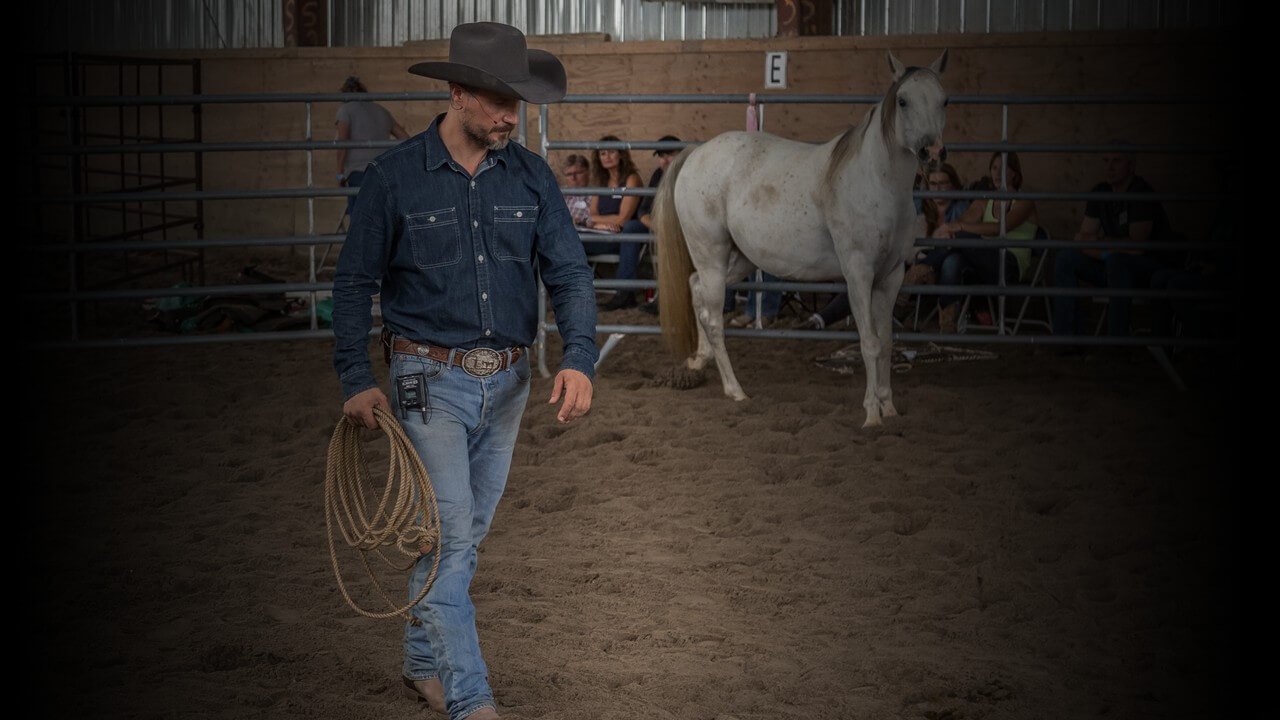
Round Pen - Moving Horse Body Parts using Human Body Language
Step Fifteen - Teach the Horse to Move Different Body Parts Using Human Body Language - Discover Horsemanship Philosophy & Methodology in the Round Pen
Goals:
Horse learns to read human body language and how to move using communication without tools
Horse learns how to move front shoulders left & right by applying cue to turn inside
Human teaches horse to come to him and join up by moving shoulders in left & right sides
Human stands beside horse hind quarters; leans towards the hind quarters and asks the horse to move hips in left & right directions
Human stands behind horse hind quarters and invites the horse to face him by moving the horse shoulders inside from left & right directions
Problems Solved:
Problems to face the human with front end and join up
A horse that can not read human body language with confidence
Horse that does not trust and accept human body language
We are now going to continue with our next important step, step fifteen, titled “Teach your horse to move different body parts using body language.” In this step, we will focus on enhancing communication by teaching our horse to respond to subtle cues, and we will do this exercise without the use of a halter, a rope, or a stick in our hands. This approach emphasizes the bond of trust and the connection we share with our horse, allowing for a more natural interaction.
I encourage my students to use their imagination and think about how the earlier steps can help them succeed in Step fifteen, as I ask them questions to how these steps will work together in order for us to reach our goals.
I often get interesting responses from them as they eagerly search for answers to my question. Why do I ask instead of just giving them the answers? I want them to engage their minds and learn how to communicate better with the horse. This helps them think critically and reflect on key aspects of our horsemanship journey together.
So, I will begin our next step by asking how we are going to move the body parts of our horse all together in a coordinated fashion? You may be thinking, very easily, Russ; as you have already taught this concept to us. We will start by asking our horse to go forward by employing step # one. My next question is how do we clearly explain and effectively teach our horse to move the front shoulders away from us without having our horse simply walk away and instead remain standing still? Again, you are correct if you answer that we are going to utilize step # 5, which is “Teach your horse to turn outside,” along with step # 3, “Teach your horse to stop and face you.” By implementing step # five “Turn outside,” your horse will take a step away from you, and then you will immediately release the pressure to create a positive response, followed by using step # 3, “Stop and Face.” Now, with your horse positioned to face you, use step # 4, “Turn inside,” and over time, your horse will learn to turn 360 degrees by pivoting with the hindquarters, and this can be accomplished without applying any pressure on the horse's face, whether through a halter or by tapping the horse with our hands on its neck or shoulders. We also do not need to poke the horse’s rib cage or use a horsemanship stick to achieve success in this particular step. Your horse should feel free, relaxed, and willing to accept your cues and signals. This is what I call great horsemanship!
I will continue to explain in detail how our horse will effectively move his shoulders and execute a full 360-degree turn by engaging his hindquarters. We begin this process by standing beside our horse’s hindquarters, where we will implement step #4, titled “Turn Inside.” At this stage, your horse will naturally turn his head and look in your direction, and with practice, he will gradually turn and face you directly. It is important to practice this step repeatedly, allowing your horse to understand and learn it thoroughly. Each time your horse successfully turns to face you, take a step back from his hindquarters in a smooth circular motion, which encourages him to use his inside shoulder and initiate a comprehensive 360-degree turn utilizing his hindquarters. Remember, during this exercise, you are not relying on any tools, which helps to foster a strong understanding and bond between you and your horse. Additionally, it is crucial to ensure that you have successfully completed step #11, “Build Confidence to the Hind End,” so that you can work safely and effectively around your horse’s hindquarters during this step.
My next question is how do you think we can effectively move the hindquarters of our horse without relying on the use of a stick or a flag, or by tapping our horse in the hindquarters, and without applying any physical pressure at all? I encourage you to use your imagination and think critically about the various ways we can utilize our body cues and our body language to achieve success in this particular step. I will be here to assist you and explain the steps involved in the process.
Start by inviting your horse to the center of the round pen, where your horse should ideally stand in a nice, calm manner. Now, take a moment to walk around your horse, remembering that it does not matter whether you choose to go to the left or to the right; the direction is entirely up to you. With your horse standing still and relaxed, begin walking around your horse while gradually making your circle smaller and smaller. Eventually, you will find yourself walking quite close to your horse. Keep in mind that this is a new step for your horse, so we will need to break these steps down into smaller, more manageable pieces to ensure that your horse understands our intentions and does not become anxious or upset. Our ultimate goal is to help our horse learn and achieve success in this important step.
Begin by walking closely next to your horse, making sure he stands still and does not turn his head to look at you. Stop when you are positioned between his shoulders and hindquarters, then take a moment to gently pet him to build a connection before slowly walking away. Repeat this until your horse is relaxed and his muscles feel soft.
Next, ask your horse to move his hindquarters. Stand again in the middle of his body and watch his body language. He may not look directly at you, but you might see his inside ear turning toward you, showing that he is attentive. To encourage movement, lean from your hips toward his hindquarters while using a clear voice command, like a soft cluck. You may notice your horse stepping back or moving away from you. This process requires time and patience, so practice consistently, and you will see improvements in your horse's responsiveness and behavior.
I will explain how to use your horse's hindquarters and shoulders by teaching him to respect your space and step away from you. Start by asking your horse to move forward. When he is moving softly and relaxed, ask him to stop parallel to the fence or round pen using the “Turn Outside” technique. Allow him to stand calmly against the fence.
Next, stand in front of your horse and apply body pressure and language to encourage him to step back. Use the round pen walls to keep his hindquarters aligned. Lean forward to signal him to move away while using a clucking sound. Raise your hands in front of him, and when he leans back, release the pressure immediately.
With practice, you will only need to lean forward and use your voice command for him to step back around the round pen in a straight line. After he masters this in the round pen, practice in the center and other open areas. Remember, you don't need tools; just use your body language to communicate with your horse using my methods in the round pen.
You can use your imagination and create a vast array of different ideas and methods to effectively communicate with your horses, as well as skillfully move their body parts, all without the use of any tools. Each day, when I am working closely with my horses, they are the ones who continuously educate me, and I find that each day, one door opens, leading to yet another door, establishing a cycle of learning that never truly ends. I am genuinely happy to unlock these doors each day and discover the treasure that lies ahead in my journey of horsemanship education alongside my wonderful horses.
You will find that when you diligently complete these important steps, this process will truly bring you and your horse closer together in a meaningful way. You have cultivated a valuable friendship that grows through mutual trust and the ability to read each other's signals and emotions. Your horse will no longer be afraid of your hands and your body language, which fosters a safe environment. In return, you will also develop a deeper trust in your horse when you are together, enhancing your overall partnership.
As you both continue to progress through my philosophy and methodology in the round pen, you will discover that you will genuinely enjoy playing and engaging with each other. You will find a mutual desire to please one another and take great pleasure in the meaningful relationship that is steadily building between you. So, let’s take these important steps seriously and invest the time to learn about your equine partner, while also allowing your horse the opportunity to learn about you, ultimately growing to become one harmonious unit together.
To learn more about the complete step by step program including tutorial and videos of “Discover Horsemanship Philosophy & Methodology in the Round Pen” join Russ Krachun Performance Horsemanship at the “True Grit Academy” Virtual Education.