
Step Fourteen - Discover Horsemanship Philosophy & Methodology in the Round Pen
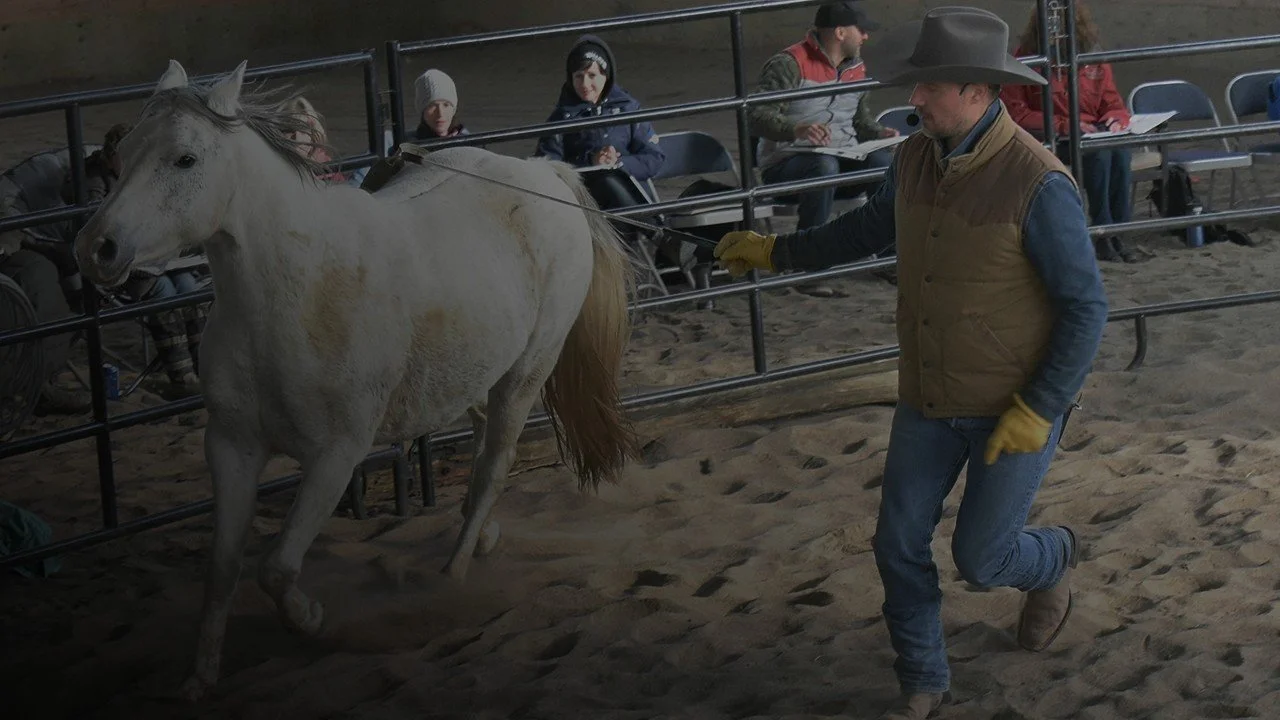
Round Pen - Lead and Build Confidence with Flag
Step Fourteen - Teach Your Horse to Lead and Build Confidence with Flag and Bull Whip - Discover Horsemanship Philosophy & Methodology in the Round Pen
Goals:
Horse learns to give to pressure from the left and right sides in the halter
Horse learns to give to pressure and follow human
Horse learns to give to pressure - lead- and accept flag and bull whip
The horse learns to give to pressure, control emotions, build confidence and trust human
Horse learns to stand still, be free without halter and accept flag and bull whip
Problems Solved:
A horse that does not give to pressure
A horse that does not stand tied
A horse that can not control emotions with loud sounds and moving objects
A horse that does not lead
Throughout our horsemanship journey, we are consistently explaining the various steps to our horses and are not simply demanding the horse to respond to us in the ways we desire. It is crucial that we clearly communicate the specific goals we want to achieve in each step, allowing the horse to grasp our intentions effectively. I have frequently heard from many individuals who believe they are speaking the language of horses, yet they still resort to using a whip, stick, or other training tools to teach the horse respect, often coercing the horse into compliance rather than fostering an environment of mutual understanding and respect.
Let us take a moment to truly understand each other; we are never going to be a horse, and as such, we cannot authentically speak the intricate language of horses. Some individuals may believe that they can communicate with horses effectively because they have closely observed or diligently studied these magnificent animals and how they interact with one another in the wild, in the paddock, or even in the barn environment. However, the reality remains that we do not share the same sensory experiences as horses, we don’t process information in the same way that a horse does, we lack their unique instincts, and ultimately, we are human beings who think and perceive the world quite differently.
I have often found myself pondering deeply who it is that truly decides the rules or the manners that we read about in books concerning the interactions between the horse and the human? Who can definitively say who is right or who is wrong in this complex relationship? Numerous individuals have claimed that when a horse does not respect your personal space, it is appropriate to tap the horse with various tools or to shake a rope towards its chin in an effort to encourage the horse to back away. However, I immediately respond to these assertions by stating that it is not necessarily that the horse lacks respect for us; rather, it is that we fail to show respect for the horse when we resort to using these aggressive methods. This miscommunication turns into a form of aggression that can be detrimental to the relationship. Additionally, many people refer to their methods as "natural horsemanship," claiming that we are speaking the horse's language. I ask you, what is truly natural about these practices?
Completing the steps in my training approach in the round pen allows the horse to understand our human language while we also learn to accept the horse's way of communicating. This creates harmony and strengthens our partnership. While I have used whips and tools in the past, my experiences and ongoing pursuit of gentler methods help me understand the horse better and improve my horsemanship. Following these steps not only makes the process more enjoyable for the horse but also simplifies our work together. We can achieve our horsemanship goals effectively without harsh methods, recognizing that all interactions with the horse involve some level of control.
As you have learned from my previous instructional methods and detailed past steps, I always break everything down into manageable steps for better clarity. This thoughtful approach not only makes it easy for our horses to understand the training process, but it also fosters a more enjoyable experience for us as trainers. Together, we will find satisfaction in working with our horses, driven by a clear purpose and the rewarding sense of achievement as we reach our goals in each carefully structured step.
I will now share with you an effective method for teaching our horse to lead without the use of a stick, which may involve tapping the hindquarters or holding a stick behind the horse and tapping it when we walk forward. Additionally, we will avoid the technique of pulling the horse sideways in order to create an imbalance that encourages it to take a step forward. Instead, I will outline a more gentle and respectful approach to leading the horse successfully.
In the previous steps that I have already shared with you, you have already learned how to effectively ask our horse to move forward, and our horse has become familiar with how to give to pressure. We also understand how to guide the horse to the center of the round pen without the use of ropes, employing the skills we developed in those previous steps. Therefore, once again, let’s take this opportunity to put this intricate puzzle together, and together we will achieve success in this important next step of our training journey.
We will begin our session by carefully bringing our horse to the center of the round pen, ensuring that the horse is standing still, calm, and relaxed in his demeanor. Once we have established this peaceful state, we will then take a step back and introduce the rope halter to our horse in a manner that is both gentle and non-threatening. How will we achieve this? We will first approach our horse while confidently holding the halter in one hand, allowing our horse to clearly see the halter without any attempt to hide it. It is important for the horse to feel comfortable, so we will let him sniff the halter, becoming familiar with it, and then, after a brief moment, we will walk away with the halter in our possession. Your horse should feel at ease with you and the halter. Although this process may sound straightforward and simple, some horses may actually become startled and try to flee from you. If your horse does choose to run away, you will calmly bring him back to the center of the round pen and patiently try once more. Keep attempting this approach until the horse is comfortably standing still, allowing you the opportunity to rub the halter gently all over his body. Your horse must be calm and relaxed throughout this process. To assist him in lowering his head, use one hand on his nose and position the other hand on his poll, applying consistent and gentle pressure without pinching the sensitive area on the top of his head. When your horse responds and lowers his head, you will be ready to place the halter securely on him.
I have observed, even today, that many individuals continue to teach others an outdated method of pinching the horse with their hands on the poll. When this technique is employed and the horse feels uncomfortable, he will instinctively lower his head. However, consider this: if someone were to pinch your neck, would that be a pleasant experience for you? Instead, I encourage you to apply this pressure gently and consistently on the horse's poll, repeating this process over time until the horse truly understands what is being asked of him. This approach is similar to playing basketball or bouncing a ball — with practice and patience, the horse will eventually lower his head for you automatically simply by the gentle touch on his head. It really is that easy and straightforward, requiring no aggression, just pure love and respect for your horse. Once this understanding is established, the horse will lower his head willingly, allowing you to easily place the rope halter on him.
The next step in our training process is to teach him how to lead and move forward confidently. Once again, this step is very easy to manage and implement effectively. We will begin by stepping away from our horse approximately ten steps, then we will ask him to move forward by utilizing the techniques we've practiced in previous sessions. Remember, your horse is already familiar with your body language and your voice commands, which makes this part of the training much more manageable. We have previously taught our horse to respond positively to pressure cues, which will aid us here. When he moves forward, you will gently bring him closer to you by applying a bit of pressure with the horsemanship rope that is securely attached to the halter. When the horse reaches a point very close to you, it is important to release the pressure and allow him to travel away from you freely. Repeat this step consistently until your horse becomes comfortable and proficient, leading him to walk around you very closely and with ease.
As the horse is walking closely beside you and he is maneuvering around you in a nice and calm manner, you will then gradually begin to walk together with him, and you will be truly amazed at how effortlessly he responds and allows himself to be led. You are not feeling upset, your horse is also not upset, and you have not needed to tap him to encourage him to move forward, nor have you pulled on his head, resulting in him avoiding your grasp by pulling away. You did not rely on whips or sticks for guidance, and your horse is willingly leading and following your movements. It is entirely possible to continue this step at any speed that you desire, allowing for a comfortable flow between you and your horse. This is what I refer to as effective communication. I have taken the time to explain this concept in a way that your horse can understand, as I always break everything down into manageable steps, helping my horse to truly comprehend my intentions.
We are now fully prepared to build confidence in our horse using the carefully outlined steps we have practiced together. I like to incorporate various tools such as a bull whip, a flag, plastic bags, and a tarp, among others, to enhance the learning experience. Without even realizing it, your horse has already begun to develop crucial confidence, simply by working through the previous steps we have established. Your horse now understands how to better control his emotions and is gradually becoming more self-assured with each passing step. At the same time, you are also learning how to effectively control your own emotions while skillfully explaining these important steps to your horse.
It seems that people often make a considerable deal out of the fact that a horse is afraid of tarps, flags, various sounds, or different types of obstacles. I witness this situation every day when we are initially introducing these challenges to our horses. In these moments, we inadvertently start to act like a predator! When individuals take a tarp, a plastic bag, or even a saddle pad and approach their horse in an attempt to show or touch him with it, the horse instinctively turns to jump away or, in some cases, right on top of you. Then, the common question arises: why is he so nervous and afraid? I encourage you to take a moment to reflect on this scenario. Imagine if you have a fear of riding horses, yet deep down, you truly desire to learn; when your coach provides you with a helmet and instructs you to mount the horse, assuring you that the horse will not run away because he will be holding tightly onto the rope, and that everything will be just fine. Do you honestly think that your fear will simply vanish in that moment? Absolutely not; your fear will remain because you have yet to develop the necessary confidence with that particular horse. You will need ample time to get to know the horse better and build your own confidence. This is precisely what happens with our horses when we first introduce them to unfamiliar and potentially frightening obstacles—they need time to cultivate their confidence and come to the realization that these new experiences pose no threat to them at all.
So how do we effectively introduce these potentially scary things to our horse in a safe manner? You are correct if you answered by gently walking away from our horse while still holding the scary object in your hand. We already know the basics of how to lead our horse, so we will maintain the appropriate distance by staying at the end of our horsemanship rope, which measures fifteen feet long. With this ample space, we will turn our back to our horse and start to walk away, all while holding the plastic bag, tarp, or any other object that you decide to impact your horse's learning experience with. Gradually, as he observes the object from a distance, he will start to become more confident, allowing him to lead and follow you in an increasingly calm manner. Once we have reached this point, we will then face him once again and continue to lead him until he becomes calm and self-assured in the presence of the previously frightening object.
Eventually, we will stop leading him and begin to gradually introduce all of the potentially scary obstacles to the horse while he remains standing still, calm, and relaxed. When my horse has fully accepted my presence, I will step forward strategically, inching closer and closer until I finally reach him and touch him gently with the scary object. If your horse exhibits any signs of lack of confidence as I move closer to him, it is essential to return to the position where he felt confident and comfortable before trying once more. Remember, your horse will communicate when he is truly ready, indicating the moment when it is appropriate for you to come closer.
Some horses can become very nervous and anxious when we attempt to build their confidence using the flag or any other training tool. This process may require a substantial amount of time for the horse to fully trust and accept us as their handlers. However, an effective way to accelerate this trust-building process is to use our hands to gently touch them. When we do this, we notice that the horse becomes noticeably calmer, enabling them to accept our presence and guidance much more quickly. I believe the reason for this calming effect is that, through touch, we are transferring our energy from our body to theirs, allowing the horse to understand that we are not a predator but rather a source of comfort and safety. It is through this tactile connection that we begin to establish trust and confidence with the horse. I refer to this phenomenon as magic, a unique connection that I feel Mother Nature has gifted us. It is important to note that this interaction is not merely a physical exercise; rather, it is the energy that we transfer that makes a significant difference. Some individuals may struggle to find success in this crucial step due to their own energy or because they may not possess complete confidence within themselves. In my extensive experience working with people, I have observed that both older individuals and younger ones tend to be particularly gentle with their hands, which allows them to calm animals quickly and effectively by transferring their energy with remarkable ease.
Once you have diligently followed and completed these essential steps consistently, you will find yourself able to confidently run around your horse with various tools such as a flag, whip, plastic bag, or tarps. Over time and with patience, your horse will eventually learn to stand calmly and free within the confines of the round pen, becoming more accepting of all your imaginative and unconventional ideas. It is also important to remember that once you have successfully completed each of these steps in the round pen, you can then graduate to working in a larger arena and eventually take your training out on the trail. This progression will lead you to develop a horse that is not only very confident but also safe for riding and interaction. Take your time during this process; prioritize safety, and always engage your critical thinking as you follow our structured steps methodically. To me, this thorough approach is truly the only way to achieve lasting success in all aspects of life. Do not rush this vital relationship-building phase between you and your horse; instead, focus on nurturing and strengthening your partnership step by step.
To learn more about the complete step by step program including tutorial and videos of “Discover Horsemanship Philosophy & Methodology in the Round Pen” join Russ Krachun Performance Horsemanship at the “True Grit Academy” Virtual Education.