
Step Ten - Discover Horsemanship Philosophy & Methodology in the Round Pen
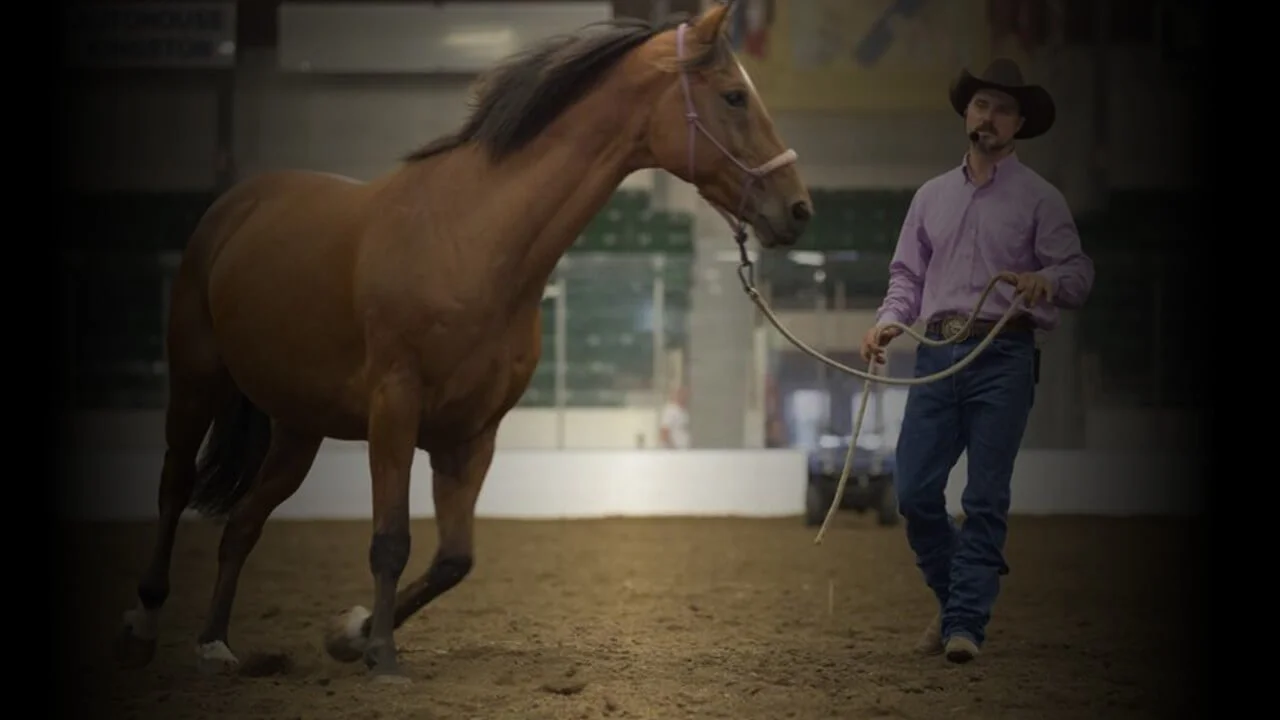
Step Ten - First Pressure from the Left and Right Direction - Discover Horsemanship Philosophy & Methodology in the Round Pen
Goals:
Horse learns to travel forward and give to the pressure from the left and right sides
Horse learns to travel forward, give to the pressure, stop and stand still
Horse learns to lead by giving to the pressure
Horse learns to lunge and gives to the pressure
Horse learns to soften in the left and right sides
Problems Solved:
Horse that does not give in to pressure
Horse that pulls back when tied
Horse that does not give in to pressure when lunging
Horse that does not lead
Horse that does not trailer load
Horse that cannot stand still on the ground or when saddled
Before I begin to explain our next step in the training process, I would like to take a moment to discuss how some horses have been started in the past, as well as how they may still be started in various ways these days. Understanding these methods can provide valuable context for our approach and highlight the evolution of horsemanship practices over time.
Horses have been started in many various ways, each with its own approach. Some are introduced to training in a round pen using a whip to encourage movement, while others may work on a lunge line in the same setting. In some methods, one person holds the horse on a lunge line while another encourages it to go forward with a whip. There are many techniques, each differing in style and intensity. I've tried some of these methods myself, which is well-known among horse trainers. However, upon reflecting on my approach, I realized that my actions did not truly represent good horsemanship. I began to see them as more harmful than helpful, which was a difficult realization.
I often wonder, what does the horse experience? Did he genuinely learn something useful from my teaching, or was he just reacting out of fear, trying to avoid stress I caused? Also, why do we need a whip when teaching lunging? This skill should be learned through clear communication and trust, not intimidation.
People often resort to using whips out of a profound fear of the horse’s power and unpredictability. They crack the whip sharply to scare the horse into moving forward, and if that method fails to elicit the desired response, they resort to physically hitting the horse on the hindquarters. This approach commonly results in the horse kicking out defensively and pulling the handler around the round pen in an effort to escape the pressure being applied, which only increases the horse's sense of fear and mistrust toward the handler. Ultimately, the handler may feel a fleeting sense of bravery for having compelled the horse to obey, but the underlying issues of fear and aggression remain unresolved.
I would like to take a moment to share another situation that I have observed, as it highlights a common practice that some trainers have employed in an attempt to teach the horse to give to pressure using what might be referred to as the old cowboy method. Traditionally, the cowboy would use a sturdy wooden post positioned strategically in the center of the round pen and then tie the horse to that post. This technique was intended to prevent the horse from either pulling the handler around or escaping entirely. However, this approach, in my opinion, does little more than exert control over the animal in a rather harsh manner, lacking any form of explanation or meaningful communication. It is high time that we put an end to this outdated practice, broaden our perspectives, and recognize that there are indeed safer and more effective ways to communicate with and understand our horses.
In my approach to horsemanship, my central idea revolves around practicing a step-by-step methodology and allowing ample time so that the horse will remain calm, which ultimately promotes a deeper understanding of the lessons being taught. Taking time is truly the key to success! When I work with my horses in a calm and patient manner, the horses are more receptive to learning what I am teaching, and I will achieve the desired results that I am diligently working toward. My philosophy and methodology in the round pen serve as the essential recipe, and the outcome is the creation of a trusting relationship and a solid, lasting foundation that we aspire to establish for our horses.
As we begin in our next step, which is step ten titled “First Pressure from the Left and Right Direction,” it is essential once again to remember that it is critically important that you have thoroughly completed each previous step successfully before moving on to this current step. If you find that you have not completed the previous steps entirely and with care, your horse may react unpredictably by pulling you around, or they may jump toward you in a sudden manner, or even rear up in a display of confusion. Additionally, they may attempt to kick toward you, which could lead to potential safety concerns, and may not fully grasp your body language signals. Therefore, it is incredibly important to avoid making mistakes, as these can lead to significant issues in your relationship and communication with your horse.
I will take this opportunity to explain the critical importance of teaching our horses to yield to pressure from both the left and right directions. When our horse learns to give to the pressure effectively, you will be rewarded with a horse that is notably softer and far less likely to pull you around while being led. A horse that consistently gives to the pressure is not only easier to handle but is also much better prepared for trailer loading when asked to move forward, or when tied, as it will not resist or pull back. Furthermore, a horse that yields to pressure will refrain from pulling on the rope when you are working on various exercises on the lunge line, as well as during confidence-building exercises involving a flag, bull whip, plastic bags, tarp, and other such objects.
When we are asking our horse to give at the poll and to be soft and supple in their movements, the horse is also engaging in essential giving to the pressure exercises. We would not be able to effectively address and fix serious issues, such as a horse that rears up or a horse that flips backwards, nor could we assist a horse that struggles to achieve softness and suppleness in the neck or hindquarters, without first teaching the horse to yield to the pressure. Therefore, let’s take our time and exercise patience throughout this process, as doing so will help ensure we achieve the results that we desire from our horses.
What steps we've learned will help us succeed with step #10, "First Pressure from the Left and Right Direction"?
The key steps are:
Step #1: Teach your horse to move forward consistently to the left and right.
Step #2: Use the lariat for an "Extended Touch" in both directions.
Step #3: Teach your horse to stop and face you from both directions.
Step #9: Build confidence with the lariat on both sides, up to the withers.
Each of these steps is crucial for our success.
So, we do not have to resort to cracking a whip or throwing a lariat in order to encourage our horse to move forward, nor is it necessary for us to lasso our horse and engage in a struggle with him in the round pen. Instead, we have effectively prepared our horse to go forward solely by utilizing our body language and our voice in a gentle and encouraging manner. We have also taught our horse to stand still without attempting to run away, and to respect our personal space, again exclusively through our body language and our voice. Additionally, we have trained our horse to remain calm and stationary while we walk around him and practice throwing the lariat from various angles, ensuring that he does not shy away or seek to escape. In the process, we have successfully built a solid foundation of confidence and trust with our lariat. We are now able to approach our horse calmly, touch him gently with the lariat, and even tap him from the muzzle to the shoulders without causing fear or anxiety. So now, let us take this comprehensive understanding and put all the pieces of this puzzle together in order to achieve the desired results we seek from step number ten.
A good lariat is essential for safety. It should not tighten too much or harm your horse. A high-quality lariat allows you to release pressure when necessary, ensuring the safety of both you and your horse.
Start by carefully opening the loop of the lariat, and then walk confidently up to your horse to place the open loop gently over his head. Once the loop is in position, take a few steps back to the center of the round pen and ask your horse to move forward. At this particular moment, I typically pose a reflective question to my students, asking them what specific actions they are currently undertaking and what insights they have gained through my Philosophy and Methodology teachings in the Round Pen. In response, my students often share that they are engaged in lunging their horse. I then follow up with another query: where is the lung whip? Their reply is usually, "We don’t need one!" This response fills me with immense gratification. It brings me great joy to realize that I have successfully conveyed my message to yet another individual who will now possess a deeper understanding of horses and their behavior.
To teach your horse to respond to pressure for the first time, start by moving forward at a steady pace. Gently slide your opposite hand away from the one holding the lariat and step back slightly. This step acts as a signal. Just like when you asked your horse to turn inside, stepping back helps them understand your cue. When you do this, your horse should look at you and naturally give to the pressure. Practice this while standing still to reinforce the idea and try it at different speeds to improve communication. You can also practice this when navigating obstacles or on trail rides to help your horse learn in various situations.
You may also find yourself wondering why we need to slide our hands along the lariat while we are working with our horses. The answer lies in understanding that this action serves as an important pre-cue; it is essentially a signal to our horse that we are approaching them, and that something significant is about to unfold. Over time, as we practice this movement consistently, our horse will begin to comprehend its meaning. It is crucial to finish this step with care and consistency, and as always, it is essential to remember to take your time throughout the process. This foundational step plays a vital role in developing your overall horsemanship skills.
Many people have been hurt by horses that suddenly reared up or broke free from control, sometimes falling backward because they didn't know how to teach their horses to respond to pressure properly. These incidents can be avoided. As a committed horseman, I believe it is my responsibility to educate others about this important issue and help you create a safe and positive relationship with your horses.
To learn more about the complete step by step program including tutorial and videos of “Discover Horsemanship Philosophy & Methodology in the Round Pen” join Russ Krachun Performance Horsemanship at the “True Grit Academy” Virtual Education.