
Step Eleven - Discover Horsemanship Philosophy & Methodology in the Round Pen
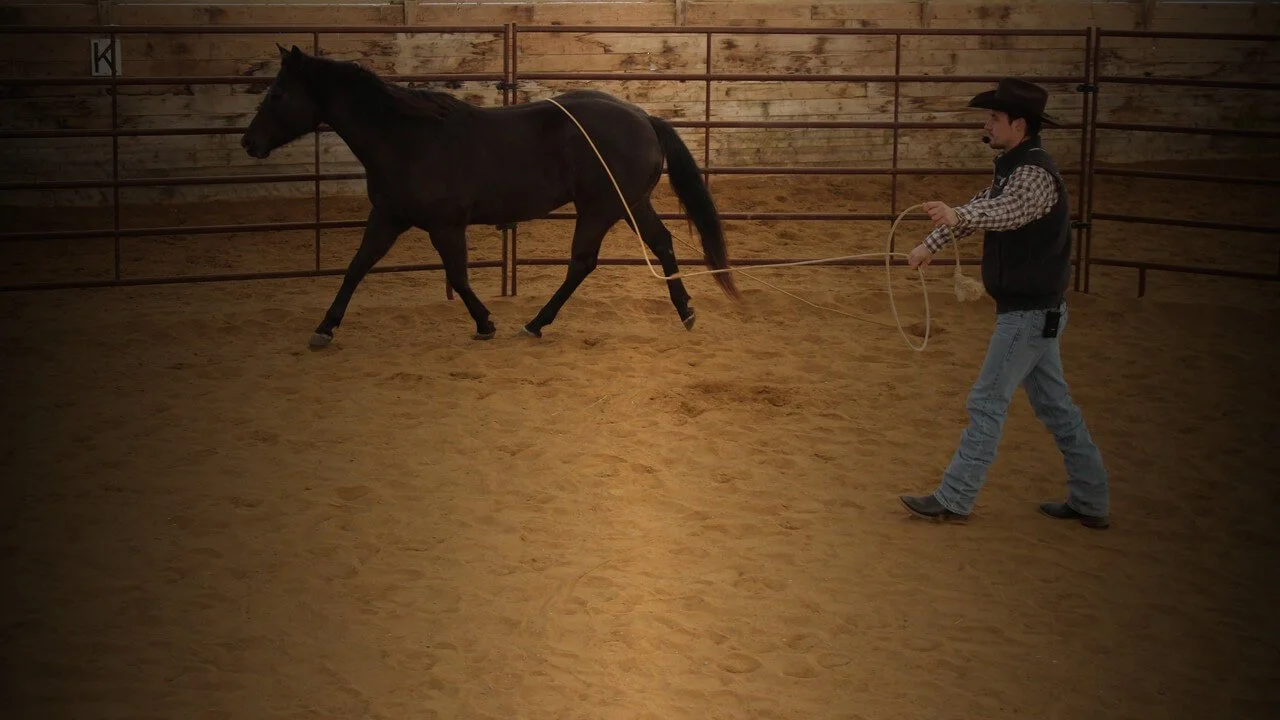
Round Pen - Building Confidence to Hind with Lariat
Step Eleven - Build Confidence to the Hind End with Lariat from the Left and Right Direction - Discover Horsemanship Philosophy & Methodology in the Round Pen
Goals:
Horse travels forward and accepts the lariat from the hindquarters in the left and right sides
Horse learns to trust the touch of the human to the hindquarters and hind legs
The horse learns to accept human touch and respect the human without kicking out
Builds safety and confidence to the hind end
Problems Solved:
Lack of confidence in the hind quarters of the horse to both horse & human
Improved safety while grooming, tacking, trimming or shoeing, or feeding in the stall.
Kicking Issues
I would like to begin by sharing a story about an incident between people and their horses and problems of horses not having confidence with their hind end.
My Uncle Collin, who first introduced me to the fascinating world of horses, once shared a particularly harrowing story that he and my mother experienced during their childhood. One sunny day, my uncle decided to go out to catch his horse so they could spend a fun-filled day riding together with my mother. However, it turned out to be anything but enjoyable for him. As he approached the horse and walked behind it, the animal unexpectedly kicked him squarely in the face, resulting in him losing all of his teeth. He was incredibly fortunate that the horse’s powerful kick did not result in more severe injuries or worse outcomes. Following that traumatic incident, he underwent several surgeries, and in the process, he learned a profoundly valuable lesson about the importance of proper horsemanship. My uncle later took the time to explain to me exactly what he did wrong that day and why the horse reacted the way it did. What he emphasized was that it is crucial for the horse to respect the human from the hind end, and equally important for us to exercise extreme caution when working around the horse’s hindquarters, as dangerous situations and accidents can occur unexpectedly in real life. This impactful lesson left a lasting impression on me, and it is the primary reason why safety is a top priority in my horsemanship program.
We all realize that unfortunate accidents can happen, and some of these accidents may not be preventable despite our best efforts. Additionally, it is important to acknowledge that we all learn valuable lessons from our own experiences and mistakes. I often find myself wishing that I could turn back time so that every horse could be thoroughly educated and trained to understand how to behave safely, particularly in the sensitive area of their hind end.
In sharing this personal story from my life, I would like to take a moment to remind you of the important lessons that arise from our daily routines and interactions with our horses. For instance, when we groom our horses, we often secure them in cross ties, which allows us to move around them more easily. However, as we walk behind them and ask them to lift their back legs for hoof cleaning, we must remain aware that these actions can inadvertently place us in potentially dangerous situations. Additionally, we often require the horse to move from our left to our right sides, which can provoke unexpected responses such as kicking or pushing, possibly leading to being pinned against a wall. These behaviors serve as a clear indication that the horse may not feel entirely safe or secure with us in close proximity to their hindquarters.
Also, the farrier is expected to perform the essential tasks of trimming or shoeing the horse, but in this instance, the horse does not respond appropriately to his cues to pick up his feet. Instead, the horse reacts negatively, kicking out suddenly and pushing the farrier against the wall. This clearly illustrates that the horse lacks both safety and confidence in its hind end. Another example can be seen when we are teaching our horses specific maneuvers that require effective use of their hindquarters while under saddle. When we apply appropriate pressure with our legs to encourage the horse to move its hind end over, the horse's immediate reaction is to tuck its tail and begin to run, which ultimately results in the rider being bucked off. This once again demonstrates that the horse is not demonstrating safe behavior with regard to its hindquarters.
I firmly believe that it is our responsibility as horse trainers and educators to teach our horses to be safe and confident in their hindquarters; it certainly is not the horse's fault when issues arise. If we take the time to build a solid foundation starting in the round pen and focus on teaching our horse to respect us regarding their hindquarters, while also fostering their confidence on the ground, we will have successfully addressed many potential problems. This proactive approach will significantly aid in avoiding future frustrations that can occur both on the ground and under saddle for both the rider and the horse.
Over the years, I've learned that success with our horse, whether on the ground or in the saddle, relies on controlling the hindquarters. When we ensure the hindquarters are safe, our relationship with our horse becomes more enjoyable and secure.
As we start step eleven, "Build Confidence in the Hind End with a Lariat from Both Directions," remember that completing the previous steps is essential for your success in this one. It's key to our success plan.
So far, we have made significant progress; we can now confidently put the lariat on our horse without causing any distress or anxiety. Remarkably, we have achieved this without needing to throw the lariat or instigate a struggle that might frighten our horse and disrupt our relationship. Furthermore, we have successfully taught our horse to move in any direction we desire, maintaining a speed that we choose, all while ensuring that our horse remains calm and collected. At this stage, our horse understands how to yield to pressure and remains composed, neither attempting to flee from us nor pulling us around the pen in an unruly manner.
So, with the lariat securely placed around the horse's neck and the other end firmly held in your hand, begin by asking your horse to move forward. Once in motion, start to gently wiggle the lariat from side to side, creating a big loop until it is ample enough to throw behind your horse's hindquarters. At this crucial moment, it is common for the horse to suddenly accelerate and start running quite fast. It is essential to remember to maintain control over your emotions and not become frustrated or anxious, as your horse is highly attuned to your body language, and any tension could lead to undesirable outcomes. Staying calm is of utmost importance in this situation. Additionally, some horses may feel inclined to change direction unexpectedly. If this occurs, you already possess the knowledge to resolve this by employing either an inside or outside turn to effectively free the lariat. In some instances, horses may kick at the lariat several times in response to the new sensation, but with patience, they will typically stop this behavior and adjust.
I want to remind you to always use a high-quality lariat during this crucial step, as it can significantly contribute to your safety and your horse's well-being. Additionally, if you ever find yourself in a potentially dangerous situation, it is imperative to immediately release the lariat from your hands to prevent any accidents. By doing so, the horse will gradually calm down as the pressure is released, and because of the design of a good lariat, it will not tangle or cause any harm to your horse. Furthermore, it is also essential to repeat this step consistently until your horse can calmly accept the lariat being placed behind the hindquarters without any fear or resistance.
The primary goal in this crucial step is to ensure that your horse effectively stops moving forward, halting its progress completely, and then turns to face you with the lariat positioned behind its hindquarters. It is essential that the horse not only accepts the lariat but also remains relaxed and composed, standing still in a confident manner. This foundation of calmness and acceptance is vital to building trust and improving communication between you and your equine partner.
Remember to take your time and do not rush yourself or your horse during your training sessions. Patience is key, as safety is of utmost importance, and we only have one life to enjoy with our equine companions. Let’s continue to develop our partnership with our horses, focusing on each step of the process and ensuring that we foster a strong bond built on trust and understanding.
To learn more about the complete step by step program including tutorial and videos of “Discover Horsemanship Philosophy & Methodology in the Round Pen” join Russ Krachun Performance Horsemanship at the “True Grit Academy” Virtual Education.