
Step Twelve - Discover Horsemanship Philosophy & Methodology in the Round Pen
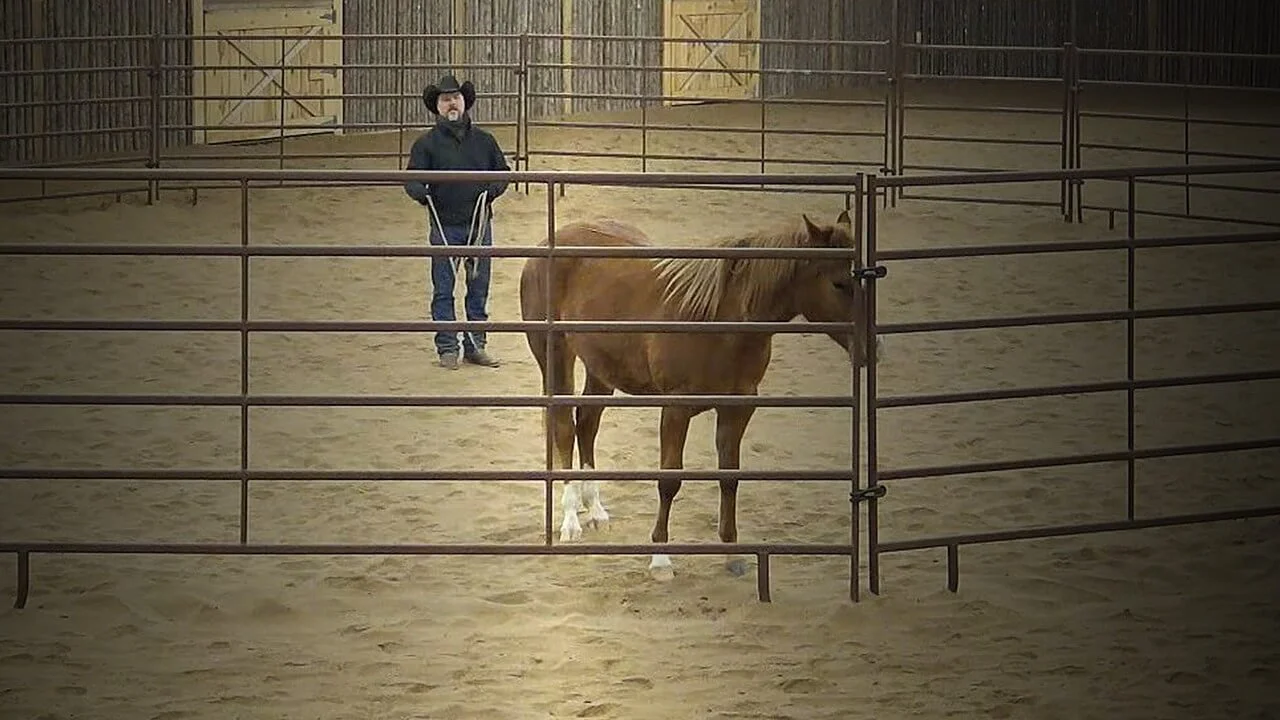
Round Pen - First Pressure to Hind End
Step Twelve - First Pressure to the Hind End from Left and Right Directions - Discover Horsemanship Philosophy & Methodology in the Round Pen
Goals:
Horse travels forward accepting the lariat to the hind quarters
Horse learns to give to the pressure with the hind quarters while traveling forward in the left and right direction
Horse learns to stand still and give to the pressure with the hind quarters when pressure is applied with lariat
Horse learns to trust human from the hind quarters and be confident and safe
Problems Solved:
Horse does not respond when pressure is applied to hind quarters
Horse kicks when pressure is applied to hind quarters
Horse does not understand to accept pressure when asked to move over, giving to pressure in the barn, on trailer, x ties, standing stall or when feeding in the stall
In this next step twelve, First Pressure to the Hind End in both directions, I will provide a more detailed explanation of how you can effectively teach and clearly explain to your horse the concept of giving to pressure in the hindquarters. This important skill not only enhances communication between you and your horse but also significantly increases your horse's safety in various situations that may arise. Additionally, I will elaborate on my belief that our hands are truly the most vital tools we possess in fostering trusting relationships and building confidence with our horses, which is essential for both training success and overall partnership.
In our extensive experiences with our horses throughout our lives, we have observed that many of the most potentially dangerous situations often arise from the hindquarters. It is essential for us to recognize and understand that this behavior is instinctive, as it reflects how horses naturally protect themselves from threats in the wild. This inherent ability to protect themselves is a testament to the impressive power and strength of the horse.
People often put themselves in risky situations while handling their horses during daily tasks. For instance, when grooming in cross ties, putting on splint boots, or cleaning hooves, a horse might kick or push against them. Sometimes, a horse won't stay still for the farrier, leading to yelling and punishment, like being hit with a rasp or kicked. The owner is then advised to hold the horse's head or use a twitch to keep it calm. Another example is during trailer loading, where a horse may kick when asked to shift its hindquarters into position.
In my opinion, it is not the horse's fault for exhibiting this behavior. It is only natural and instinctive for the horse to act in this way, as he typically would in the wild. No one has taken the time to teach him how to stand quietly, nor has anyone clearly explained to him the specific manners that we expect from him in a domestic setting.
Most people focus on breaking horses for riding because it's an exciting part of working with them. However, we should reflect on our own actions and recognize mistakes in our horsemanship. It's important to consider how our behavior affects our horses. Many accidents occur around a horse's hindquarters, often because the horse doesn't understand pressure or respect the person handling them.
My primary goal is to create safer horses through my comprehensive horsemanship program. While we understand that we cannot make horses completely safe because of their inherent survival instincts, we can certainly work diligently to improve their overall behavior and responsiveness for our enjoyment and the enjoyment of those around us. Regardless of how much trust we build over time, it remains crucial to stay vigilant and cautious both on the ground and while in the saddle to ensure the safety of both horse and rider.
As we begin our instruction in this important next step, step twelve, I want to take a moment to remind you once again that it is absolutely essential to have completed all of the previous steps that lead up to this particular stage. Each of these earlier steps lays the groundwork for your continued progress and success in your horsemanship journey.
We will start by carefully placing the lariat around the horse's neck and then gently ask our horse to move forward at the speed that we have previously determined and agreed upon. Remember that we have already taught our horse the essential principles of speed control. It is crucial for the horse to travel consistently along the wall or panel of the round pen, ensuring that he does not lean inside or attempt to change direction unexpectedly. If the horse does try to change direction or leans inwards, you will need to correct this behavior using the steps we've practiced and learned previously.
When your horse is moving calmly and maintaining the speed that we have asked of him, begin to gently wiggle the lariat to the left and then to the right, continuing this motion until you have created a large, soft loop. Once the loop is formed, carefully throw it behind the hindquarters of your horse, ensuring that you maintain a firm grip on the end of the lariat. It is important to remember that you have already practiced this skill in step eleven, titled "Building Confidence to the Hind Quarters." Your horse should now be traveling smoothly and calmly, without showing any signs of agitation, while also keeping the lariat positioned behind his hindquarters. If you have effectively completed step eleven, your horse should not react by kicking out toward you or at the lariat.
Ask your horse to turn outside using your pre cue and body language, as you practiced in step five, titled “Turn Outside.” While you encourage this turn, gently apply consistent pressure with your lariat on the horse’s hindquarters to effectively support your command and guide your horse in the desired direction. Make sure to remain attentive to your horse’s responses to ensure a smooth and harmonious transition.
You may wonder why I have asked you to intentionally pretend to turn outside; this exercise is crucial as I am teaching my horses using my carefully structured step-by-step methods. Through this process, I am also actively explaining to my horses what it is that I specifically expect from them during our training sessions. In particular, I will utilize step number five, “Turn Outside,” to effectively assist our horse in grasping the cues we will be implementing in step number twelve, “First Pressure to the Hind Quarters.” This approach is what I refer to as a pre-cue. If you neglect to incorporate this pre-cue, “Turn Outside,” into your training routine, there is a significant risk that your horse may become startled or upset when you begin to apply pressure with the lariat. Consequently, this could lead to the horse either increasing its speed or potentially kicking out either towards you or towards the lariat itself. It is of utmost importance that both you and your horse remain calm and composed; if tension arises, your chances of successfully mastering this step will diminish significantly. Aim to maintain control over your emotions, as doing so will greatly influence your horse’s behavior in turn. Take your time with this process, and ensuring that you complete this step correctly is essential so that you do not inadvertently create further issues with your horse’s training.
How do we know when we have successfully reached our goal in this particular step, and how can we determine that our horse is becoming both safe and trusting, particularly through their hind quarters? The answer is clear: it is when your horse is walking calmly, with a demeanor that is completely relaxed and at ease. Your horse should not exhibit signs of being alert or upset when you apply gentle pressure with the lariat. Instead, when he responds appropriately by giving to the pressure from his hind quarters, you should experience a feeling of softness in your hands, indicating a positive reaction. Over time, your horse will learn to stand still while facing you, with his hind quarters presented. When you apply the pressure with the lariat on his hind quarters, he will remain calm, standing still until you give him the signal to move either to the left or to the right. It is in this moment that you will clearly recognize that you have indeed accomplished this step, consistently achieving your goal.
As I mentioned previously, it is incredibly important that we consistently utilize the pre-cue in this initial step to effectively introduce this concept to our horse. In your future sessions, you will have the ability to advance your horse's training without relying on the pre-cue. If you find that you are struggling with coordination while using the lariat with your horse in the round pen, I encourage you to practice your technique beforehand, outside of the round pen environment. You can throw the lariat around a sturdy wooden pole until you feel more confident and establish better coordination. Once you feel prepared, you can then continue working with your horse in the round pen. Again, it is absolutely crucial to use a high-quality lariat to ensure that both you and your horse remain safe and free from injury. Additionally, please remember not to rush through this step; each horse is unique, and it is vital that you take your time to fully understand my intentions and ideas within this training phase.
Horses are often misunderstood simply because they do not fully trust or respect the people around them, which can lead to various incidents where people get hurt. Consequently, these individuals may decide to sell these horses, perpetuating a cycle where more people unfortunately experience injury due to their lack of understanding. Let us work together to help our horses gain a clearer understanding of who we are by methodically teaching them what we genuinely expect from them. By following these essential steps, we can build our partnerships in both the right way and the safe way. Please take your time, prioritize safety, and act responsibly in your horsemanship practices so that we can truly enjoy the fulfilling partnership with our beloved horses.
To learn more about the complete step by step program including tutorial and videos of “Discover Horsemanship Philosophy & Methodology in the Round Pen” join Russ Krachun Performance Horsemanship at the “True Grit Academy” Virtual Education.